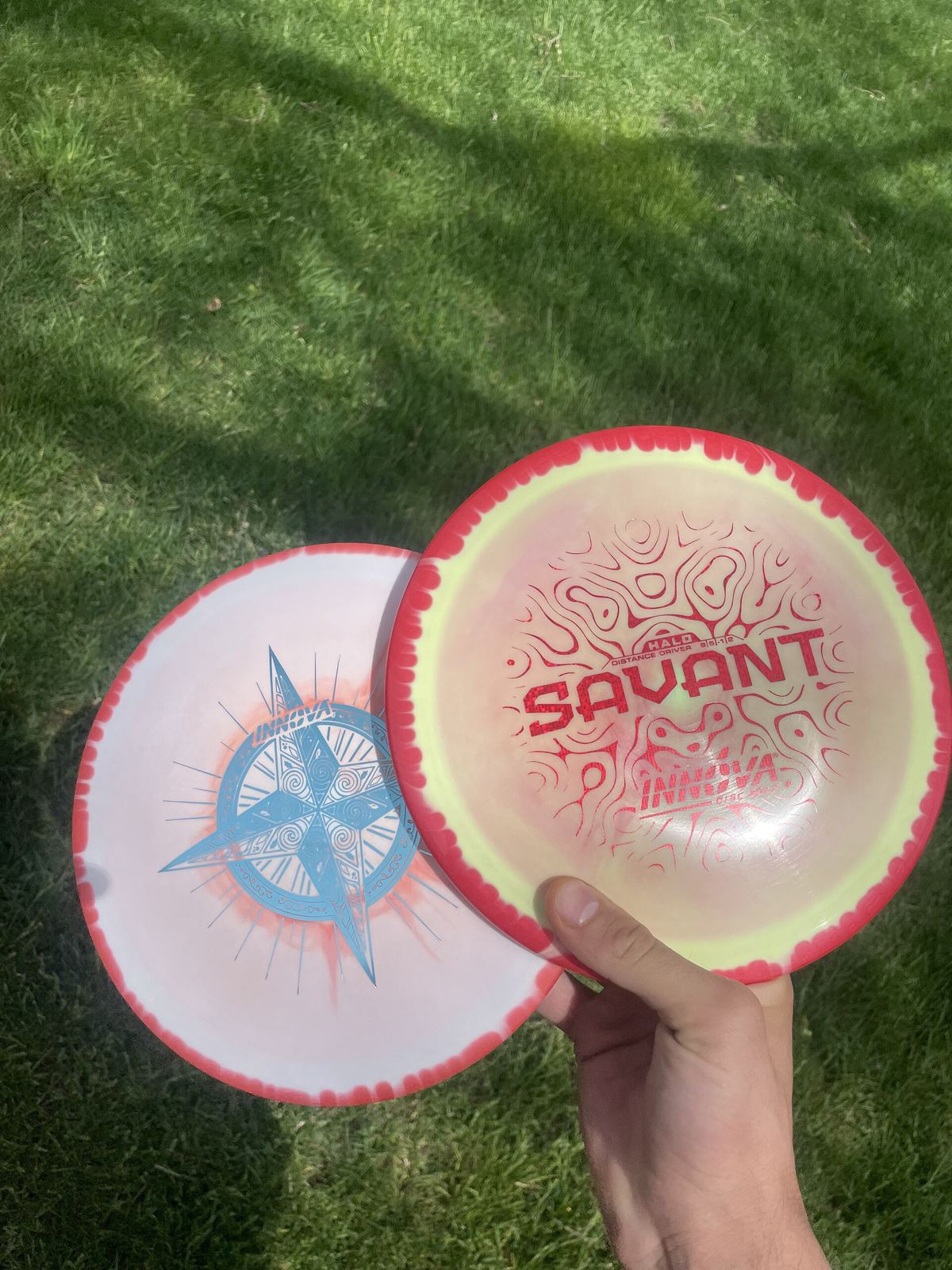
Is My Disc Legal? Equipment Rules and Approved Discs
Every bag has one: the beat-up putter with a story, a dye job, and a suspicious little crack near the rim. It has earned its retirement. The rules agree, and they’d like it to retire before your next tournament round rather than during it.
Equipment lives in the last section of the PDGA rulebook, 813 Equipment. It has two parts: 813.01 Discs and 813.02 Other Equipment. Here they are in plain English.
Related: Disc Golf Plastics Compared · Beginner Disc Golf Bag · Lost Disc Rule Explained · Excessive Time: 30 and 45 Seconds · Practice Throws Explained.
Rule one: the disc has to be PDGA approved
Discs used in play must be approved by the PDGA and meet all of the conditions in the PDGA Technical Standards. The PDGA’s Technical Standards Working Group tests submitted discs (either through an independent lab or a member with the right equipment) and publishes the ones that pass to the PDGA Approved Disc Golf Discs list.
How to check yours:
- Open the approved discs list.
- Filter by manufacturer or search the model name.
- If it’s there, the model is approved. If you can’t find it, ask your Tournament Director before the round, not after the drive.
New models land on the list all the time; the Technical Standards page shows the most recent approvals with dates.
Factory seconds and X-outs count. Per the PDGA’s Q&A (QA-EQU-2), remaindered discs of approved models (X-ed out discs, factory seconds, hot-stamp rejects) are legal, as long as they also meet the Technical Standards’ overall limits on things like weight, rim sharpness, and flexibility. Any player can still question a disc, and the TD makes the final call.
What you’re allowed to do to a disc
Once a disc leaves the factory, 813.01 allows only these changes:
- Wear and tear from playing with it.
- Moderate sanding to deal with wear and tear or small molding imperfections.
- Marking with dye or permanent marker ink.
- Adding graphics by hot stamp, ink printing, or dye, as long as it stays within the approved specs for that model.
- Removing graphics in a way that stays within those specs.
So yes, your custom dye is fine. Your name and phone number in Sharpie is not just fine, it’s encouraged (more on that below).
What makes a disc illegal
Anything else, including:
- Changing the disc’s original flight characteristics.
- Excessive sanding.
- Adding material with a detectable thickness, such as paint.
- Intentionally deforming the disc so it’s no longer circular and saucer-like.
- A crack or a hole. A cracked disc is illegal, full stop. Sentimental value is not an exception.
The Q&A has a favorite on that deforming point (QA-EQU-6): tucking the rim of a disc into itself and throwing it like a ball is illegal. It changes the flight characteristics and the disc is no longer round and saucer-like, and it doesn’t matter that the change is temporary.
The night and snow exception: when the TD has announced night or snow play, you may add a material or device to help find the disc. Lights and glow add-ons are fine then, and only then.
A questioned disc is illegal until the TD approves it. If another player or an official questions your disc, it stays out of play unless the Tournament Director signs off.
The penalties for discs
| Situation | Result |
|---|---|
| Throwing an illegal disc during play | Two penalty throws |
| Repeatedly throwing an illegal disc | Possible disqualification under Competition Manual 3.03 |
| First throw of an unmarked disc | Warning |
| Each later throw of an unmarked disc | One penalty throw each |
Mark your discs
All discs used in play, except mini marker discs, must be identifiably marked. The first throw of an unmarked disc gets a warning; every throw after that costs a penalty throw each.
A name on the disc settles who’s who when two Destroyers land together, and a phone number is the best lost-and-found system disc golf has. It’s also exactly the kind of marking 813.01 explicitly allows.
Other equipment: what helps and what crosses the line
813.02 covers everything that isn’t a disc.
Not allowed:
- Any device that directly assists in making a throw.
- Placing an object as a directional aid. No laying a disc or stick on the ground to aim at.
Allowed:
- Things that reduce or control skin abrasion: gloves, tape, bandages, gauze. The Q&A (QA-EQU-4) confirms friction gloves are fine, so converted ultimate players can relax.
- Grip helpers applied to the skin: talc, chalk, dust, or dirt.
- Medical items like knee or ankle braces.
- A towel or pad under a supporting point, as long as it’s no more than one centimeter thick when compressed. Per QA-EQU-5, that includes on your lie, in a drop zone, or in a teeing area. Rocky lie, sore knee: put the towel down.
Rangefinders are allowed too (QA-EQU-1), but you still have to throw within the time allowed by the Excessive Time rule. Measure fast.
Restocking your bag mid-round is fine (QA-EQU-3): if your favorite putter is in the car, a friend can fetch it. Don’t distract other players, don’t run the clock, and do it between holes if you can.
As with discs, a questioned device is illegal unless the TD approves it. Being seen using an illegal device at any time during a round costs two penalty throws, and repeat use can lead to disqualification under Competition Manual 3.03.
Quick reference
| Situation | Legal? |
|---|---|
| Custom dye or Sharpie name and number | Yes |
| Light sanding to smooth a nick | Yes, if moderate |
| Paint, or heavy sanding to change the flight | No, two penalty throws if thrown |
| Cracked rim | No |
| X-out or factory second of an approved model | Yes, if it meets the Technical Standards (QA-EQU-2) |
| Tucking the rim in to throw it like a ball | No (QA-EQU-6) |
| Glow stick or light, night round announced | Yes |
| Unmarked driver | Warning first, then one penalty throw per throw |
| Friction gloves | Yes (QA-EQU-4) |
| Towel under your knee, 1 cm or less compressed | Yes (QA-EQU-5) |
| Disc laid on the ground as an aiming line | No |
| Rangefinder | Yes, within Excessive Time (QA-EQU-1) |
Habits that keep your bag legal
These aren’t PDGA rules, just good sense:
- Do a crack check before a tournament. Run a thumb around every rim. The cracked one goes to the practice basket or the wall.
- Look up anything unusual. Prototype, new brand, or a gift with no stamp you recognize: check the approved list first.
- Write your name and number on everything, including the new disc you bought on the way to the course.
- Ask the TD early. A question at check-in is free. A question on hole 7 can cost two throws.
Where to read the rules yourself
- PDGA 813 Equipment
- PDGA 813.01 Discs
- PDGA 813.02 Other Equipment
- PDGA Rules Questions and Answers (QA-EQU-1 to 6)
- PDGA Technical Standards and the Approved Discs list
- PDGA Competition Manual 3.03, which 813 cites for disqualification
Rules checked on 2026-10-30 against pdga.com (813.01 last updated December 31, 2025; 813.02 last updated January 2, 2026). The PDGA updates its rules and approved-disc list regularly, and the Tournament Director has the final say on a questioned disc or device, so check the current text before you settle a call on the card.