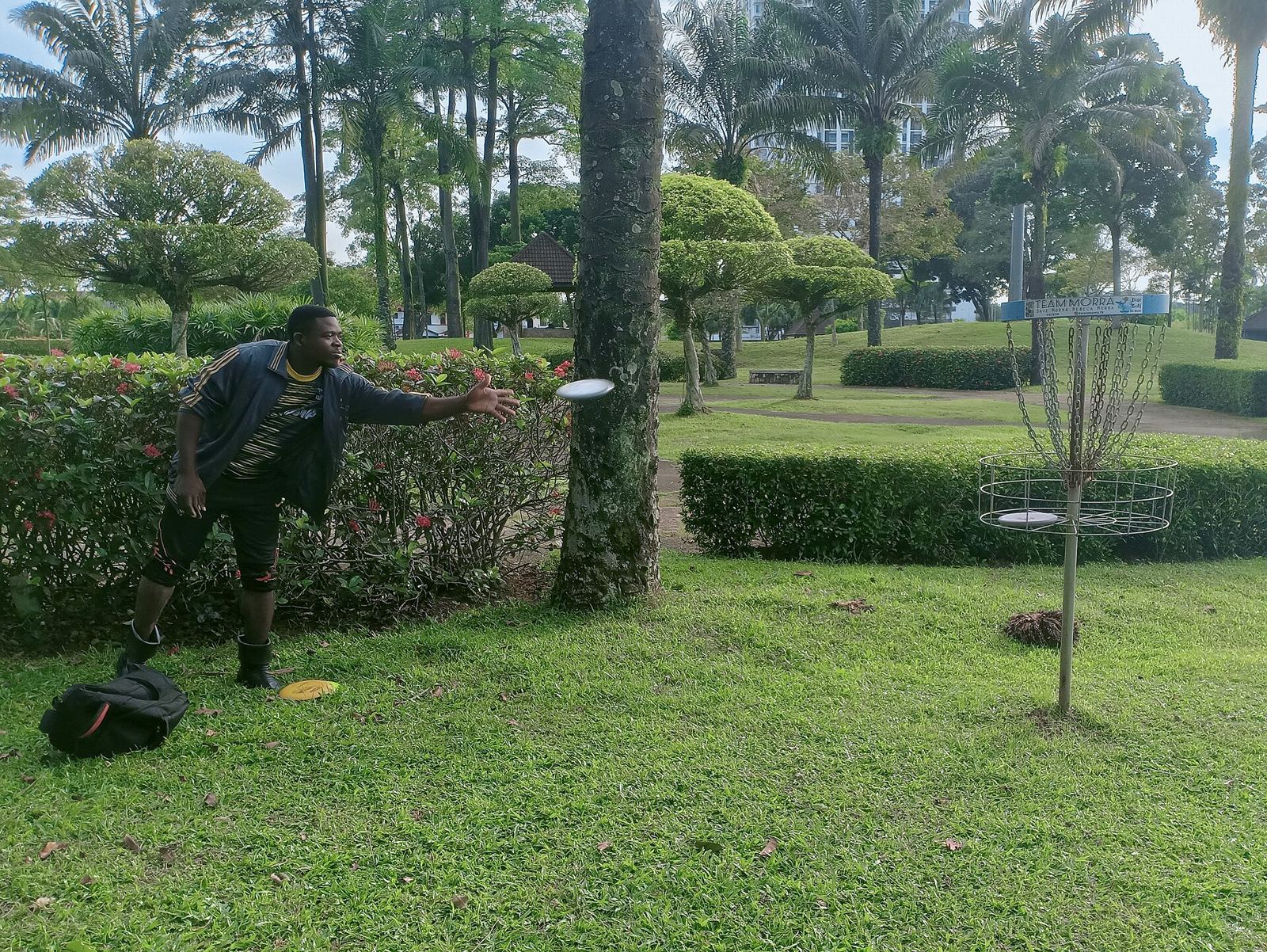
The Putting Area: Inside the 10-Meter Circle
Every course has an invisible circle around each basket, and most players only notice it when somebody yells “foot fault.” Under 806.01 Putting Area, any throw from within 10 meters of the target is a putt. That label changes exactly one thing about how you throw, and it is the thing that happens after the disc leaves your hand.
Related: Stance and Foot Faults · Putting Basics · How to Mark Your Lie · Approach Shots Inside 200 Feet · The Two-Meter Rule Explained.
Where the 10 meters is measured
806.01.A measures from the front of the lie to the base of the target. Ten meters works out to roughly 33 feet.
“Front of the lie” has a precise meaning. Under 802.05 Lie, a marked lie is a 20 cm wide by 30 cm deep rectangle sitting behind the rear edge of your marker disc. So the front of the lie is the back edge of your mini, and the measurement runs from there to the base of the basket, not from your back foot, not from the chains, and not from wherever the painted circle on your home course happens to be.
Many courses have no circle painted at all. The rule does not need one. If it’s close, pace it off or use a tape; the group settling it calmly beats the group guessing loudly.
The one thing that changes inside the circle
Your stance rules don’t change inside 10 meters. 802.07 Stance applies to every throw from a marked lie: at release you need at least one supporting point on the lie, no supporting point closer to the target than the rear edge of the marker, and every supporting point in-bounds.
What 806.01.B adds is a requirement for after release: on a putt, you must demonstrate full control of balance behind the marker disc before advancing toward the target. Fall forward, step past your mini, or stumble toward the basket before showing balance, and it’s a stance violation with one penalty throw.
Outside 10 meters, that balance requirement doesn’t exist. That’s why a jump putt or step putt from outside the circle is legal (as long as your stance at release follows 802.07), and the same motion from inside the circle is a foot fault.
What “full control of balance” looks like
The PDGA admits this one can be a judgment call. QA-COM-5 answers a player who pushes off the back foot, freezes balanced on the front foot, then walks in with “It’s hard to say,” and then gives the standard: you have to do something that breaks up the flow of movement toward the target after release. Its examples:
- A clear pause and display of balance.
- Placing your back foot on the ground behind the mark.
- Picking up your marker disc.
The Q&A’s best advice is also the simplest: leave no room for doubt. If you are actually balanced, showing it costs you half a second.
Legal putting stances people argue about
- Straddle putts. QA-PUT-1 says your other foot doesn’t have to sit on a line perpendicular to the lie. It just can’t be closer to the target than the back of your marker. Because the foot on the lie can be up to 30 cm back and 10 cm to the side, the “same distance” line is really a circle centered on the target, so your outside foot can even end up a touch closer to the basket than the foot on the lie.
- Fade-away putts. QA-STA-4 allows a back foot on the lie, a front foot ahead of it on an uphill lie, and lifting the front foot before release, as long as the stance is legal at release and you don’t go past your lie afterward.
- Holding something for support. QA-STA-2 lets you grab an in-bounds branch or object behind your lie, provided you don’t move it. A playing partner’s shoulder doesn’t count. People aren’t part of the course.
For how foot-fault calls get made and confirmed, see Stance and Foot Faults.
When the putt actually counts
807 Completing the Hole: with a basket target, the disc must be released and come to rest supported by the tray or the chains below the chain support. The Q&A covers the classic bar arguments:
- Sitting on top of the basket? Not complete. Mark below and keep going (QA-COM-2).
- Lying flat across the tray rim, spanning two nubs? Counts (QA-COM-3).
- Soft putter pushed through the side and resting inside? Counts. The flight doesn’t matter, only where it comes to rest (QA-COM-4).
- Wedged in the front of the tray after a hard skip? Counts (QA-COM-7).
- Drop-in? You can place it in the tray, but you have to let go and let it come to rest. Tapping the chains with your putter isn’t a throw (QA-COM-1).
- Your disc was resting in the chains and the next putt knocked it out? You already finished the hole (QA-COM-6).
The angry-putt penalty
You missed the short one, finished the hole, and slammed one more into the chains from two meters out. QA-PRA-3 calls that a practice throw, and 809.03 charges one penalty throw for it. The only exception is a short toss to set aside an unused disc or return a disc to a player that travels under five meters in the air.
In match play it’s even tighter. QA-MAT-1 says that once your opponent concedes a putt, the hole is complete, and throwing it anyway “to stay sharp” is a practice throw. The penalty goes onto your next hole.
Habits that keep the circle drama-free
These aren’t PDGA rules, just cheaper than a card argument:
- Measure from the back of your mini. That’s the front of your lie, and it’s where 806.01 starts counting.
- Pick one balance tell and use it every time: a pause, a back foot down behind the mark, or picking up your marker.
- Save the jump putts for outside 10 meters. If you’re not sure which side of the line you’re on, assume you’re inside.
- Pull your disc from the basket and walk. Don’t add a bonus putt.
Where to read the rules yourself
- PDGA 806.01 Putting Area
- PDGA 802.05 Lie
- PDGA 802.07 Stance
- PDGA 807 Completing the Hole
- PDGA 809.03 Practice Throw
- PDGA Rules Questions and Answers (QA-PUT-1, QA-COM-1 through QA-COM-7, QA-STA-2, QA-STA-4, QA-PRA-3, QA-MAT-1)
Rules checked against pdga.com on 2026-10-16 (806.01 last updated Mar 10, 2022; 802.05 Dec 31, 2025; 802.07, 807, and 809.03 Dec 31, 2021; Q&A Mar 18, 2026). The PDGA updates its rules most years, so check the current text before you settle a dispute on the card.